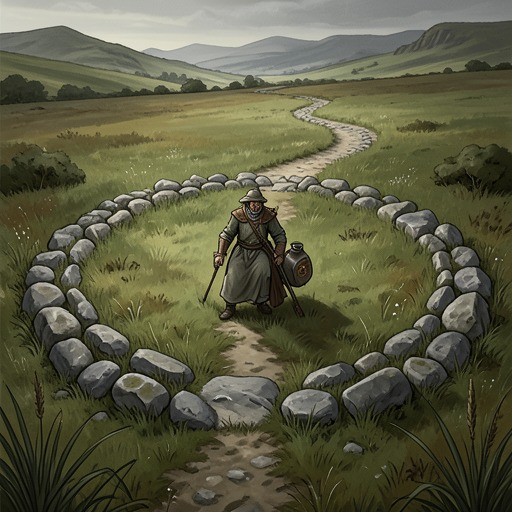
“To be whole is to be part; true voyage is return.”
The DispossessedThe inscription on Odo’s tombstone, “To be whole is to be part; true voyage is return,” condenses a central tension in the novel into two linked claims: wholeness does not mean standing apart, and a journey may find its meaning in return. Shevek reads the words in a cemetery in Nio Esseia while visiting Urras, where Odo’s remembered presence gives his encounter with the propertarian world a historical and personal dimension.
The inscription and its setting
The saying is carved on the plain, well-kept tombstone of Laia Asieo Odo, whose dates are given as 698–769. The grave stands in the old cemetery in the Trans-Sua district, in the shade of great old willows. Shevek asks, with some diffidence, to see where Odo was buried; his hosts take him there immediately, and newsmen are even allowed to photograph him beside the grave. In the midst of an official itinerary, the visit becomes an unusually direct encounter with the person whose ideas shaped the society Shevek came from.
The inscription is notably spare: its two clauses set a proposition about belonging beside a proposition about travel. “To be whole is to be part” resists the idea that completeness requires isolation; the self becomes whole through relation to others. “True voyage is return” gives movement a circular form, making arrival back at a point of origin—not endless departure—the measure of a journey. The clauses illuminate one another: return matters because the traveler is not self-sufficient, but connected to a home and a community.
Shevek’s encounter with Odo’s memory
The cemetery visit occurs amid a sequence of official presentations designed to show Shevek the institutions and achievements of A-Io. In Nio Esseia, a city of five million, he is taken to Capitol Square, government buildings, museums, schools, factories, a steel mill, a fusion plant, housing, courts, and the busy Sua Estuary. The grave is different from these displays. It does not present an institution’s account of its own success; instead, it places Shevek before Odo’s name and a brief statement of political and ethical principle.
The contrast sharpens when Shevek later addresses the Council of World Governments in Rodarred. He argues for free communication and mutual recognition between the New World and the Old, and receives a ten-minute standing ovation. Yet the respectable weeklies praise the speech without quoting it, popular papers do not reproduce it, and Shevek has the unsettling feeling that nobody has heard him. Beside Odo’s tomb, the inscription’s compact words remain available for reading; in the public forum, a message can be applauded and still fail to circulate. The juxtaposition makes communication more than the delivery of a speech: it requires recognition and participation.
Return as a governing idea
The inscription resonates with the larger contrast between Urras and Anarres. Shevek is fascinated by what he sees on Urras, but the abundance and novelty of the tourist circuit eventually overwhelm him. After several weeks, he wants to return to the University, settle down, and think through what he has witnessed. His departure from the sightseeing itinerary toward sustained work gives the idea of return a concrete form: travel has enlarged his experience, but does not erase his ties to the place from which he came.
The saying does not make return a simple restoration of the past. Its first clause insists that wholeness is relational, while Shevek’s appeal for communication reaches beyond either world toward mutual recognition. Read in that context, the tombstone’s paired claims hold together belonging and openness: the traveler returns not as an isolated self, but as someone whose relation to home and to others gives the journey significance. The inscription thus serves both as Odo’s epitaph and as a concise frame for Shevek’s passage between worlds.